DNA marker technology for traceability and authentication
How it works
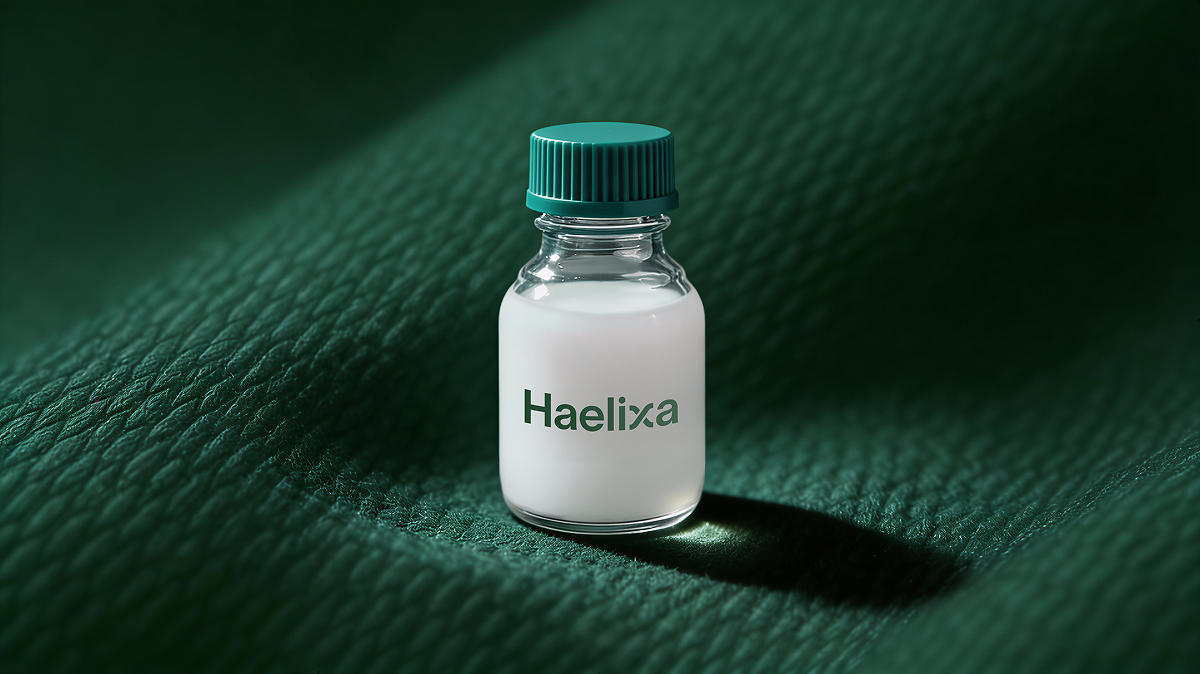
Haelixa applies a unique DNA marker, built with natural DNA sequences, to raw materials, components or finished products. The marker is invisible, harmless, highly secure and cannot be removed.
Samples are taken from the material or product and analysed with forensic qPCR, in certified laboratories or on site. qPCR detects the marker even in very small quantities, at any stage of the supply chain.
Results are documented in a Certificate of Analysis, giving brands forensic proof of origin, authenticity and recycled content, and supporting regulatory compliance.
Communicate with honesty, integrity, and pride, backed by science and transparency through the Haelixa technology.
Where to apply
Explore how DNA technology enables traceability and authenticity across materials and industries.
| Industry | Purpose | Application | |
|---|---|---|---|
| Traceability | Textile, apparel, precious metals & gemstones. | End-to-end proof of origin and material integrity across the entire supply chain. | Premium fibres, yarns, and fabrics traced from source to final product. |
| Authenticity | Luxury (bags, watches, jewellery), precious metals & gemstones. | Authenticate every product and prevent counterfeits from entering the supply chain. | Authentication of watches, jewelry and high-value accessories (e.g. bags). |
Our DNA Marker
Engineered to meet the most rigorous industry standards and designed for reliable, audit-ready verification.
- Vegan and non-GMO
- Compliant with GOTS, OEKO-TEX® STANDARD 100 and ECO PASSPORT
- Unique with distinct DNA for each supplier, brand, or material
- Scalable and easy to integrate into production processes
- Built to be resistant to harsh processing
- Harmless and recognized as safe by the FDA (GRAS notice)
- Invisible: does not affect the look, feel or quality of the product


Why choose TraceDNA™ for textile supply chains?
In-Product methods, such as Haelixa’s encapsulated DNA marker, combine versatility, stability and scalability without compromising safety. The marker is highly secure and cannot be removed.
Off-Product methods, such as certifications, rely on documents. Supply chain documentation and labels can be falsified and may not correspond to the actual product.
On-Product solutions, like barcodes and RFID, provide better tamper resistance but are less versatile.
| Feature |  Haelixa: DNA tracers | Dyes and pigment tracers | Isotope based | Certificates |
| Method | In-Product | In-Product | In-Product | Off-Product |
| Versatility | High | Limited to selected fibers | Limited to natural fibers in mapped areas | High |
| Security | High – keylock mechanism | Medium | Medium | Low – not linked to the product |
| Third party verification | Yes | No | Yes | Yes |
| Stability | High – detectable after dyeing, bleaching, washing | Challenging after dyeing | Medium – affected by processing | Paper trail only |
| Toxicity | Safe – recognized as safe by the FDA (GRAS) | May include rare earth metals | Safe | Safe |
| Scalability | High – very effective spray mechanism | Medium – depending on materials | Medium – requires expensive mapping | Medium – depends on verification method |
Why choose ProofDNA™ for product authentication?
In-Product methods, such as ProofDNA™, Haelixa’s encapsulated DNA marker, offer unmatched versatility and stability. The marker is tamper-proof, scalable, and safe. It cannot be removed, tampered with, or altered.
Off-Product methods, such as visual indicators and printed identifiers lack reliability. They can be replicated or copied, and rely on human inspection rather than proof.
On-Product solutions, like electronic tags and digital systems improve tracking but can be removed, cloned, or fail to verify the product itself.
| Approach | Material proof | Digital systems | Electronic tags | Printed identifiers | Visual indicators |
| Examples | DNA markers | Blockchain, DPP | RFID, NFC | Serial numbers, QR codes | Holograms, labels |
| What it does | Proves physical authenticity | Record product history | Identify and track items | Track identity | Suggest authenticity |
| Consideration | Requires application during production | Depend on data input, don’t verify product itself | Can be removed, cloned or transferred | Can be copied or linked to fake items | Can be replicated, relies on human inspection |
| Security Level | High | Medium | Medium | Low–Medium | Low |
Traceability inspired by the Swiss Alps
We use markers built with natural DNA sequences, inspired by Swiss mountain herbs, to mark and trace fibres. Each project receives its own natural, science-based signature for verified origin and authenticity.
Applied in seconds. Harmless. Invisible. Resilient across the entire supply chain.

Frequently asked questions
Both use the same Haelixa DNA marker. TraceDNA™ follows materials such as cotton, cashmere or recycled fibres through the supply chain to prove their origin. ProofDNA™ marks luxury products such as watches, jewellery and leather goods to prove their authenticity.
Haelixa uses physical traceability: the DNA marker is embedded in the material, so the proof travels with the product itself. It can identify single mines, lots and supply chain steps, and can distinguish recycled from conventional materials. No complex database is required, and testing can be done with a portable device. Haelixa can create as many distinct markers as a project needs.
Yes. The marker is harmless to people and the environment: it is vegan, biodegradable and recognized as safe by the FDA (GRAS notice). For textiles, it is compliant with GOTS, OEKO-TEX® STANDARD 100 and ECO PASSPORT.
Verification uses quantitative PCR (qPCR) to confirm project-specific DNA markers with a clear forensic result. Laboratory analysis in certified labs delivers results within five business days, with a Certificate of Analysis. For luxury products, the ProofDNA™ Reader gives on-site results within minutes. The test is non-destructive.
The DNA is protected in a capsule, which makes it highly stable. It withstands chemical treatments of both natural and synthetic textiles. Gold melting and surface layer removal are the only industrial treatments the marker does not survive.
Tried and trusted