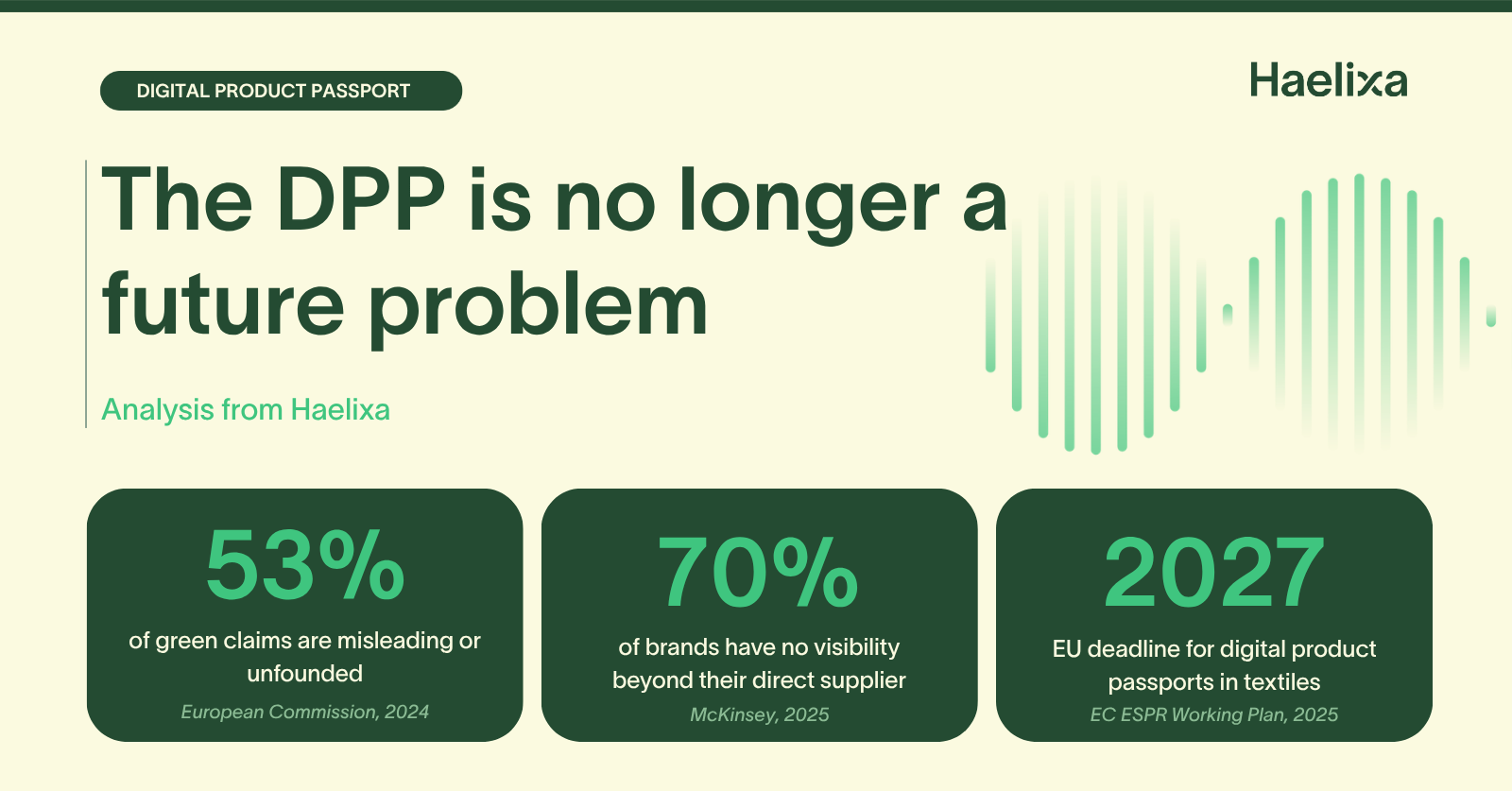
The Digital Product Passport began as a regulatory direction with many open interpretations. For most companies, it remained largely conceptual, something to address later, when the rules were finalised.
That phase is over.
From 2027, the EU’s Digital Product Passport will require verified, traceable data on material composition, origin, and lifecycle across the entire supply chain (ESPR Regulation,EU 2024). The organisations that move early will not only reduce compliance risk, they will also help shape how these requirements are implemented in practice.
“Legislators increasingly view traceability, even in complex supply chains, as feasible. They are ramping up the pressure on companies to demonstrate supply chain visibility.” – World Economic Forum, 2024
Three structural gaps to address
1. DATA DOES NOT EXIST WHERE IT NEEDS TO
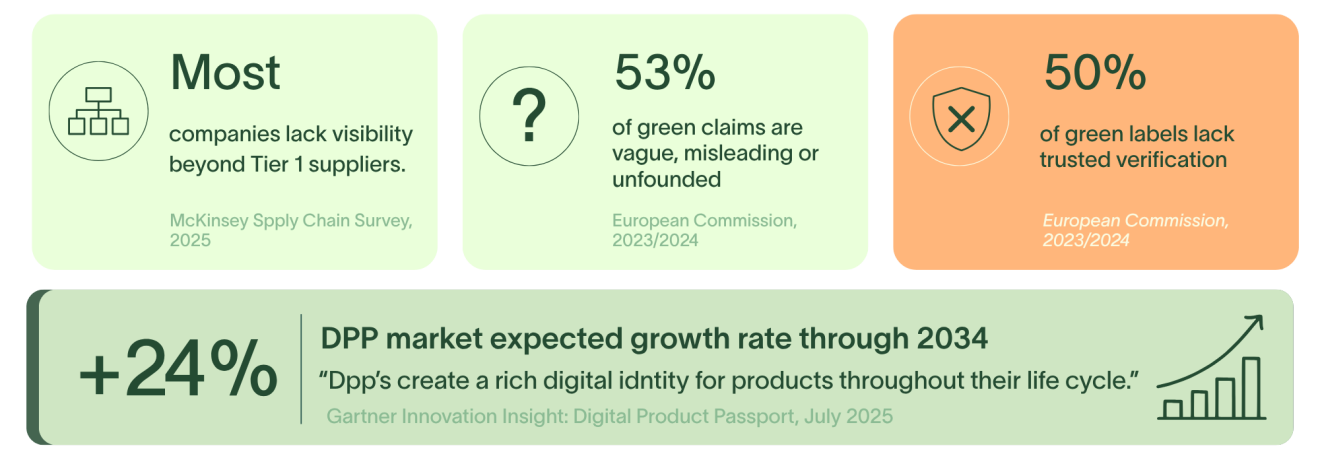
The DPP is built on the assumption that verified, product-level data exists and can be traced across the entire supply chain. For most companies, it doesn’t. Data gets lost between tiers, locked in spreadsheets, or reconstructed after the fact. Certificates and labels can be duplicated. In 2025, many brands still face fragmented supplier data, inconsistent declarations, and limited visibility beyond Tier 1 (Euverify, November 2025).
2. TIER 1 READINESS IS NOT DPP READINESS
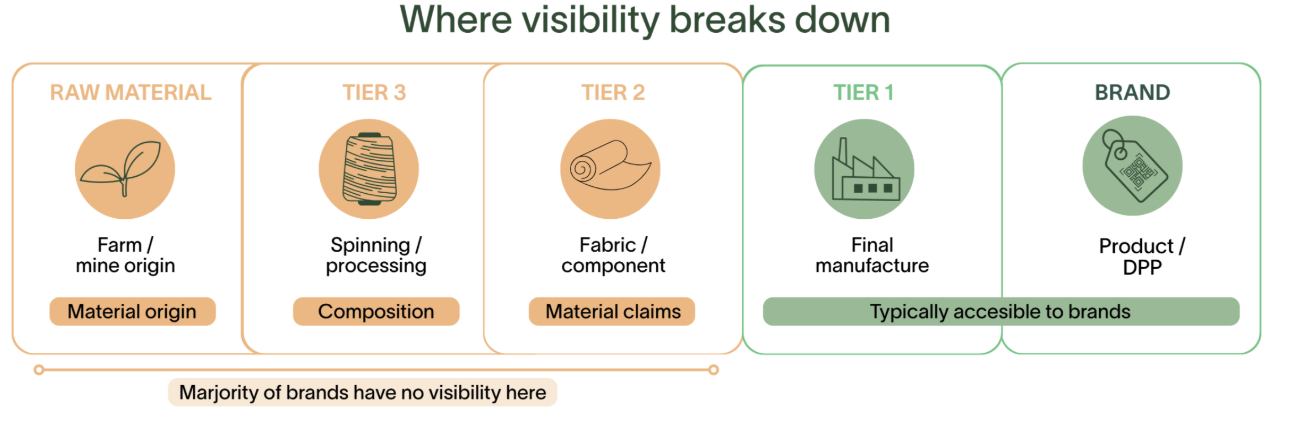
DPP compliance built only on Tier 1 data will not hold. The most critical material data, fibre origin, composition, material claims, is generated beyond Tier 1, where visibility remains limited for most brands.
Gathering upstream data from suppliers is usually a process that can take up to a year. DPP readiness is not a sprint, it is a structural transformation that must begin well before the 2027 deadline (Trimco Group DPP Guide, 2025).
3. THE DPP REQUIRES PHYSICAL EVIDENCE, NOT JUST DIGITAL RECORDS
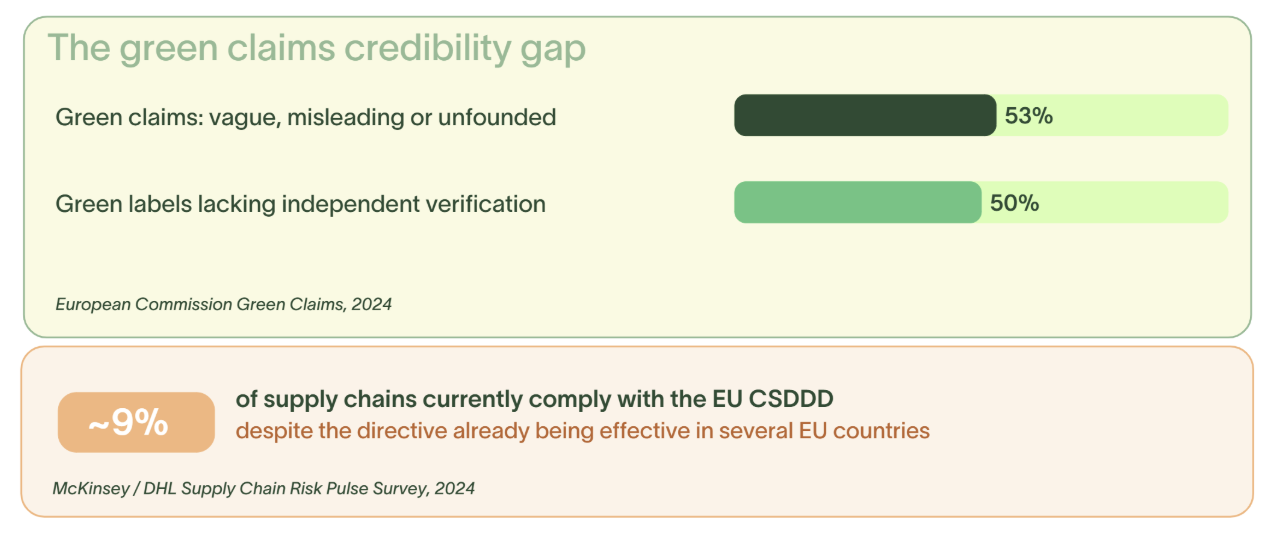
A Digital Product Passport is only as credible as the physical evidence behind it. Research reaffirmed by the European Commission in 2024 confirms that 53% of green claims are vague, misleading or unfounded, and 50% of green labels lack independent verification (European Commission Green Claims, 2024).
“DPP implementation is a business transformation, not just a regulatory fix. It requires strategic commitment to use digital technologies and embed sustainability into core business processes.” – Deloitte Switzerland, Digital Product Passport Report, May 2026
Forensic proof of what a material is and where it came from is what regulators and auditors will ultimately require. Structured data is necessary. It is not sufficient.
This is where Haelixa TraceDNA™ provides a fundamental layer of verification.
Make proof physical
Whether you are a brand or a manufacturer, the data requirements will be finalised by 2026-2027, and waiting until enforcement begins could make compliance much more costly.
“DPPs are not a project, they represent a permanent operational shift. The brands that begin preparing now will not only meet compliance expectations but will also set the standard for what responsible, transparent business looks like.” – Shameek Ghosh, CEO, TrusTrace
Speed matters too. When a new disruption hits, the average response time across supply chains is approximately two weeks, more than one full Sales & Operations execution cycle. Companies with physical verification embedded at origin can act immediately rather than reconstruct the evidence chain under pressure (McKinsey / DHL, 2024).
What Haelixa TraceDNA™ provides

TraceDNA™ gives brands and manufacturers something DPP compliance will require but cannot create: verified, product-level data at the point of origin.
An invisible, resistant DNA marker, built with natural DNA sequences, recognised as safe by the FDA, applied directly to the material where it is made. It travels with the fibre through every stage of the supply chain and can be retrieved and verified with a simple swab at any point.
TraceDNA™ enables physical proof of origin, bridging the gap between digital data requirements and real-world verification.
“The question is no longer whether traceability will be required, it’s whether your proof will hold up when it is.” – Patrick Strumpf, CEO Haelixa
Timing is now a strategic variable
The ESPR Working Plan (April 2025) confirms textiles and apparel as a first-priority product group, with the delegated act for DPP requirements expected around 2027 and mandatory compliance likely from 2028 at the earliest. Companies that begin now structuring their data, extending visibility beyond Tier 1, and embedding physical verification at the point of production will be positioned to meet the requirement.
According to a Commission-mandated Textile Preparatory Study, early DPP implementations are expected to focus on material composition, manufacturing processes, core environmental indicators, chemical compliance, basic traceability, and durability (European Commission, December 2025).
67% of the world’s top luxury brands have already piloted or launched DPP programmes. The regulation is accelerating a shift that leading brands are turning into competitive advantage (Vogue Business Index, via Shopify Enterprise, 2025).
Companies that begin now structuring their data, extending visibility beyond Tier 1, and embedding physical verification at the point of production will be positioned to meet the requirements.
For brands and manufacturers, this shift is no longer theoretical, it is already happening.